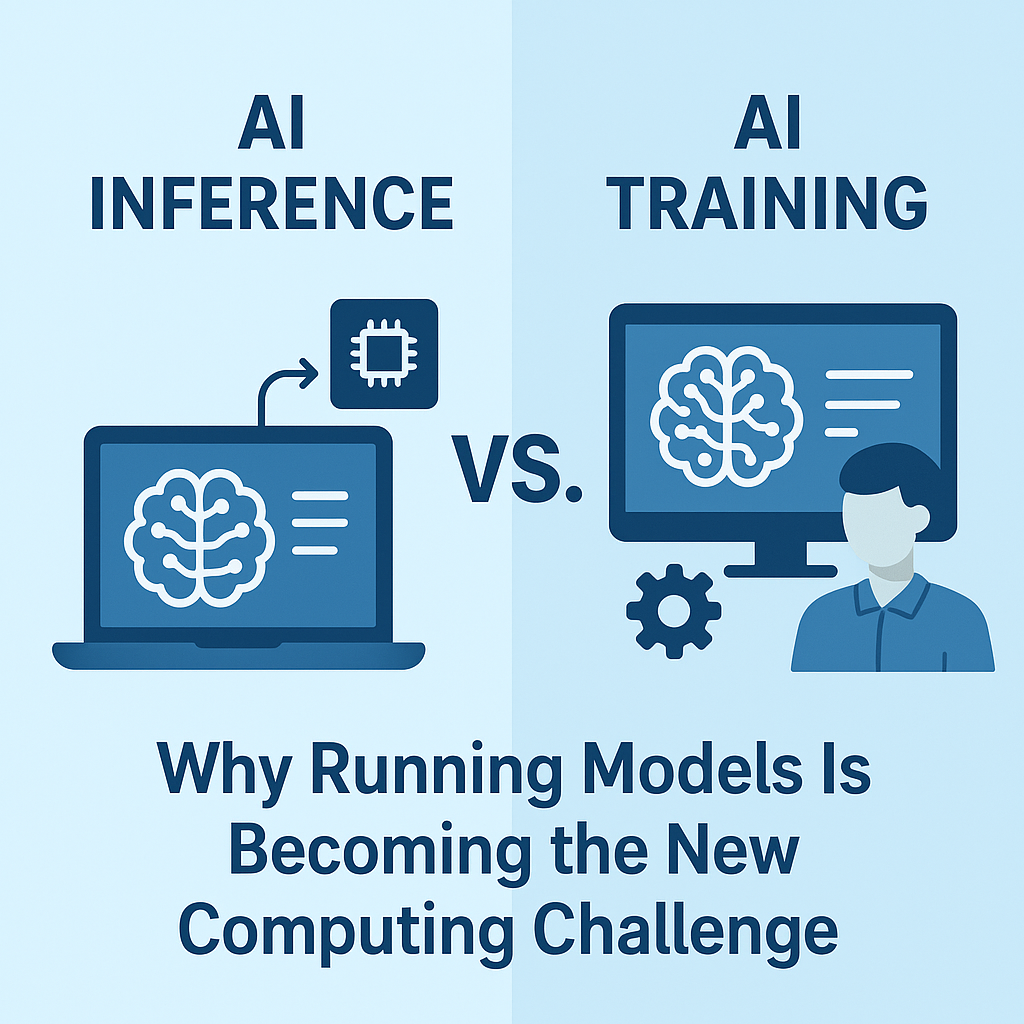
AI Inference vs. AI Training: Why Running Models Is Becoming the New Computing Challenge

AI Inference vs. AI Training: Why Running Models Is Becoming the New Computing Challenge

For years, the spotlight in artificial intelligence has been on training: collecting data, building models, and spending massive compute to “teach” neural networks how to recognize patterns. But as AI moves from demos to everyday products, a new bottleneck is taking center stage—inference. Inference is what happens when a trained model is used to generate answers, predictions, or recommendations in real time (or near real time). In other words, training gets the headlines, but inference is rapidly becoming the true “new computing challenge.” This shift is reshaping how companies design infrastructure, optimize costs, and scale AI systems—especially when billions of requests per day, strict latency requirements, and energy constraints collide.

Training vs. Inference: The Core Difference

To understand why inference is now such a big deal, it helps to define the two terms clearly.

AI Training

Training is the process of teaching an AI model using data and learning algorithms. During training, the model repeatedly sees examples and adjusts its internal parameters to reduce error. Training is typically computationally expensive because it involves:
  • Large datasets (sometimes millions or billions of examples)
  • Many iterations/epochs through the data
  • High memory requirements (to store activations/gradients)
  • Specialized hardware (often GPUs/TPUs)
Training is usually done periodically. A model might be trained once, then deployed for inference for weeks, months, or even longer.

AI Inference

Inference is the process of using the trained model to produce outputs for new inputs. This includes tasks like:
  • Chatbot responses and language generation
  • Recommendation ranking (e-commerce, streaming)
  • Real-time object detection (security cameras, robotics)
  • Speech-to-text and translation
  • Forecasting demand or predicting anomalies
Inference happens continuously. If your application is used by customers all day, every day, inference runs at enormous scale.

Why Inference Is Becoming the Bigger Challenge

At first glance, training seems like the bigger problem: it’s slower and requires more compute per training run. But the key difference is frequency and scale. Inference is repeated endlessly, while training is comparatively occasional.

1) Inference Runs Billions of Times

In many AI products, inference calls occur far more often than training cycles. A chatbot might need to respond to thousands of messages per second. A recommendation engine might score millions of candidate items per minute. Each forward pass through the model consumes compute. So even if each inference request is “cheaper” than a training step, the total cost over time can surpass training costs dramatically.

2) Latency Requirements Are Tight

Users expect responsiveness. If an AI system takes too long, it feels broken. This is especially true for:
  • Customer support chat
  • Voice assistants
  • Gaming or interactive systems
  • Financial decisioning
  • Industrial monitoring with fast reaction times
Low latency means you can’t simply throw more hardware at the problem without careful engineering. You must optimize model architecture, batching strategies, memory usage, and serving pipelines.

3) Energy and Sustainability Constraints Matter

Inference is increasingly energy-intensive because it’s done at scale. Data centers have power limits, and energy costs affect operating budgets and sustainability goals. This creates pressure to run models more efficiently: better hardware utilization, quantization (using fewer bits), model compression, and smarter routing that avoids unnecessary computation.

4) The Model Era Has Shifted From “Big Training” to “Always-On AI”

Modern AI products are no longer limited to batch jobs or offline analysis. They’re embedded in apps, websites, and devices. That means inference has to be reliable, scalable, and cost-effective. Training improves the model’s capability, but inference determines the actual user experience.

Cost Breakdown: Why Serving Can Outspend Training

Many organizations discovered an uncomfortable truth: the cost to serve a model can dominate the total lifecycle expense. Here’s a simplified way to think about it:
  • Training is a large one-time (or periodic) investment.
  • Inference repeats for every user action and every system event.
As usage grows, inference costs scale linearly (or near linearly) with traffic. If a model is popular—especially a generative model—the cost to generate responses can spike quickly. That’s why companies are turning the same level of attention toward inference optimization that they once devoted to training.

The Real Engineering Work: Making Inference Fast and Cheap

Inference isn’t just “run the model.” It requires an entire serving ecosystem. The goal is to maximize throughput (requests processed per second) while minimizing latency and cost.

Model Optimization Techniques

Several strategies reduce inference cost without fully sacrificing quality:
  • Quantization: Reduce the precision of weights and activations (e.g., from 32-bit floating point to 8-bit integers). This lowers memory bandwidth and speeds up computation.
  • Pruning: Remove less important weights to reduce compute.
  • Distillation: Train a smaller “student” model to mimic a larger “teacher” model, improving speed and cost.
  • Knowledge distillation + quantization: Combine techniques for greater gains.
  • Efficient architectures: Use model designs optimized for inference (e.g., smaller variants, better attention mechanisms, or sparse computation).

System-Level Optimizations

Even a well-optimized model can be expensive if the serving infrastructure is inefficient. Common approaches include:
  • Batching: Combine multiple requests to utilize hardware more efficiently (with careful control to keep latency acceptable).
  • GPU/accelerator utilization: Reduce idle time by scheduling workloads effectively.
  • KV cache management (for transformers): Reuse intermediate states during generation to avoid redundant computation.
  • Prefill vs. decode optimizations: Generative models have different stages, and optimizing both can improve performance.
  • Autoscaling: Scale resources up and down based on demand.
  • Model routing: Send easy requests to smaller models and hard requests to larger ones.

Generative AI Makes Inference Even More Expensive

Inference becomes particularly challenging for generative AI (e.g., text generation) because output is produced token by token. Each token requires a forward pass step (though optimizations exist). This can make throughput and latency harder to manage. In practical systems, this means companies must plan for:
  • Token budgets: Limiting maximum output length to control cost.
  • Streaming responses: Start sending output quickly rather than waiting for the full completion.
  • Stopping criteria: End generation as soon as the output is complete.
  • Fallback strategies: Use different models depending on the request complexity.

On-Device Inference vs. Cloud Inference

Another reason inference is now a major challenge is that the deployment choices have broadened.

Cloud inference

Cloud offers scale and powerful hardware. But it introduces network latency, egress costs, and availability concerns. For user-facing apps, the user experience is partly determined by how quickly requests travel to servers and how fast the model returns outputs.

Edge and on-device inference

Running models on phones, cars, or IoT devices can reduce latency and protect privacy. But devices have constrained compute, memory, and battery life. That pushes teams to use smaller models, quantization, and inference-optimized frameworks. Whether inference runs in the cloud or on-device, the theme is the same: inference efficiency becomes the main differentiator.

Why “Running Models” Is the New Computing Challenge

Historically, computing challenges were often associated with training large systems, building databases, and processing big batches of data. Now, the challenge is persistent and real-time: keep models running reliably under load. “Running models” includes:
  • Maintaining throughput during traffic spikes
  • Controlling costs as usage scales
  • Ensuring consistent quality (model updates, monitoring)
  • Reducing latency without breaking service-level objectives
  • Managing safety and policy constraints in production
In short, inference turns AI from a research project into an operational system. That’s why it feels like the new computing challenge—it blends performance engineering, financial planning, and reliability engineering.

How to Think Like an Inference Engineer

If you’re building or managing AI systems, you can adopt a “compute-for-inference” mindset:

Start with the user experience target

Define acceptable latency and throughput. Then design your model and serving pipeline around those requirements.

Measure cost per outcome

Instead of only measuring GPU-hours, track cost per successful request, cost per generated token, or cost per recommendation. This helps justify model changes and caching strategies.

Plan for growth

A system that works at 1,000 requests per second may struggle at 50,000. Choose architectures that scale and include autoscaling and caching from day one.

Use the right mix of models

Not every request needs the largest model. Model routing and tiered deployments can deliver better quality-to-cost ratios.

Future Trends: Where Inference Is Headed

Inference optimization is a fast-moving area. Expect advances in:
  • Specialized inference accelerators designed for transformer workloads
  • More efficient attention mechanisms to reduce compute during generation
  • Better compilation and runtime optimizers to squeeze more performance from existing hardware
  • Hybrid models combining smaller local models with cloud “assist” for complex cases
  • Improved caching and retrieval integration to reduce the amount of generation needed
The industry will keep investing in training, but the biggest operational breakthroughs will increasingly come from inference innovations.

Conclusion: Training Builds the Engine, Inference Powers the Journey

AI training is where models learn to perform. But inference is where AI lives—where it answers questions, generates content, and helps users make decisions. As AI becomes more embedded in products and services, inference becomes the dominant compute and cost driver. That’s why the new computing challenge isn’t only about building smarter models. It’s about running them: making generation fast, affordable, and reliable at scale. In the AI era, success belongs to teams that can optimize both intelligence and implementation—because users don’t experience training. They experience inference. If you want your AI system to thrive, start thinking beyond the model. Think about the entire path from request to response—and remember: training may get you to launch, but inference is what keeps the lights on.