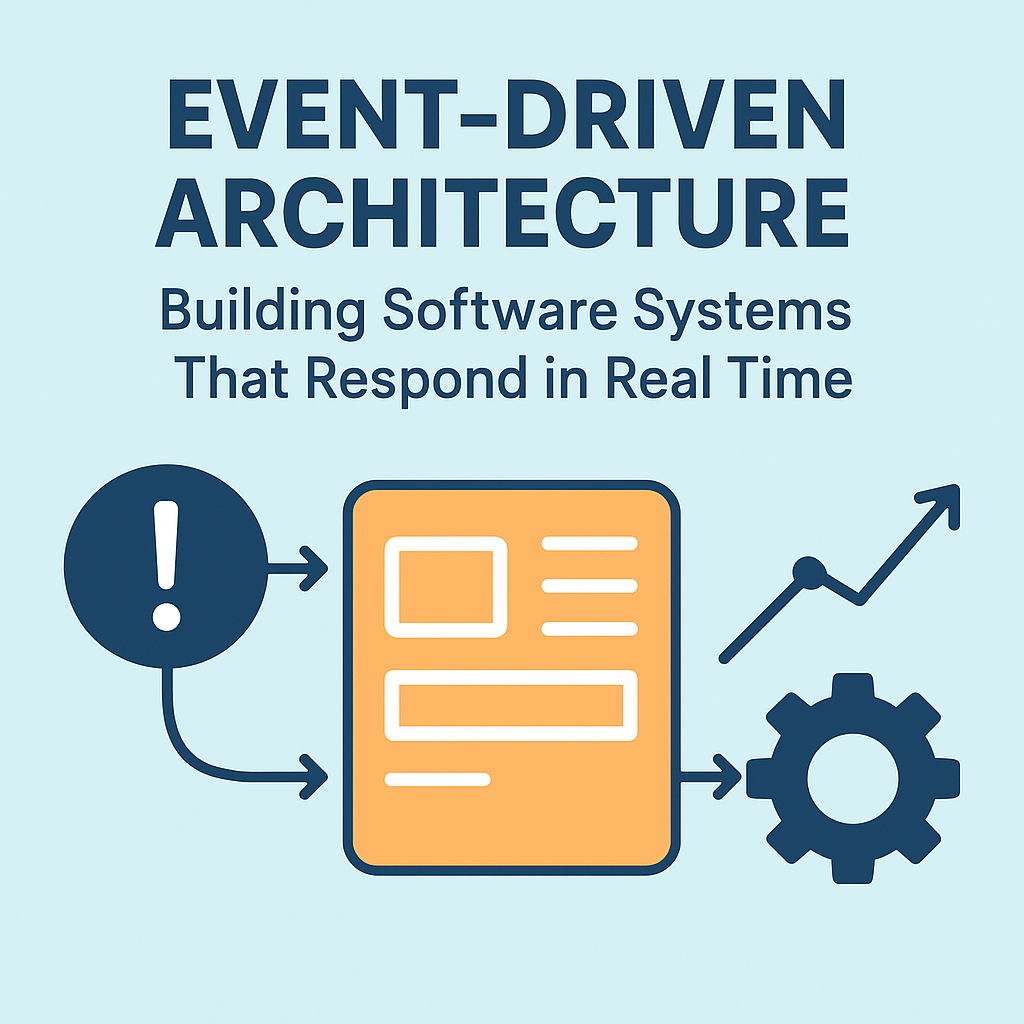
Event-Driven Architecture: Building Software Systems That Respond in Real Time
What Is Event-Driven Architecture?
- OrderPlaced
- UserSignedUp
- PaymentCaptured
- TemperatureThresholdExceeded
- DeviceWentOffline
Why Event-Driven Systems Feel “Real Time”
- Asynchronous communication: Publishers don’t wait for subscribers to finish, so the system avoids bottlenecks.
- Decoupling: Services evolve independently; changes in one component don’t force others to be rewritten.
- Near-instant propagation: When an event is emitted, subscribers can react immediately using a queue or streaming pipeline.
- Parallel processing: Multiple subscribers can handle the same event concurrently.
Key Building Blocks of Event-Driven Architecture
1) Event Producers
2) Event Consumers
3) Event Transport (Message Brokers / Streaming Platforms)
- Message brokers (e.g., RabbitMQ, ActiveMQ)
- Streaming platforms (e.g., Apache Kafka, Pulsar)
4) Event Schemas
5) Observability
Different Styles of Event-Driven Architecture
Publish/Subscribe (Pub/Sub)
Command + Event (CQRS-Friendly)
Event-Carried State Transfer (Sometimes)
Designing for Real-Time Responsiveness
Keep Events Small and Focused
Use Correlation IDs for End-to-End Traceability
Choose Appropriate Delivery Semantics
- At-most-once (may drop events; fast but risky for critical workflows)
- At-least-once (retries possible; duplicates may occur)
- Exactly-once (harder in practice; often approximated)
Idempotency: The Secret Weapon for Reliable Real Time
- When an event arrives, check whether it has already been processed using an event ID.
- If yes, skip the action.
- If no, perform the action and record the processed ID.
Handling Backpressure and Event Storms
Scale Consumers Horizontally
Throttle or Defer Non-Critical Work
Set and Monitor Consumer Lag
Event Versioning Without Breaking Everything
- Backward compatibility: Add fields in a way existing consumers can ignore.
- Versioned schemas: Use schema evolution tools or explicit event version fields.
- Deprecation policies: Plan how long you support old event formats.
Building Event-Driven Systems: A Practical Workflow
Step 1: Identify Domain Events
Step 2: Map Consumers to Events
Step 3: Define Event Contracts (Schemas)
Step 4: Implement Publishing and Subscribing
Step 5: Add Observability from Day One
- Event publish rates
- Consumer processing time
- Error counts and dead-letter queue (DLQ) usage
- Consumer lag
Step 6: Test with Realistic Load
Common Pitfalls (And How to Avoid Them)
Pitfall 1: Treating Events Like Direct Calls
Pitfall 2: Spaghetti Event Dependencies
Pitfall 3: No Dead-Letter Strategy
Pitfall 4: Ignoring Backward Compatibility
Where Event-Driven Architecture Shines
- Real-time updates matter (notifications, live dashboards, collaboration tools)
- Multiple systems must react (billing, inventory, analytics, risk scoring)
- Loose coupling is essential (microservices, multi-team platforms)
- Workloads are bursty (seasonal traffic, event spikes)
The Future of Real-Time Systems: More Streams, More Intelligence
- Streaming analytics for real-time insights
- AI-driven anomaly detection that reacts to patterns in event streams
- Operational intelligence using observability data turned into alerts automatically
- Event-based workflows that coordinate long-running processes