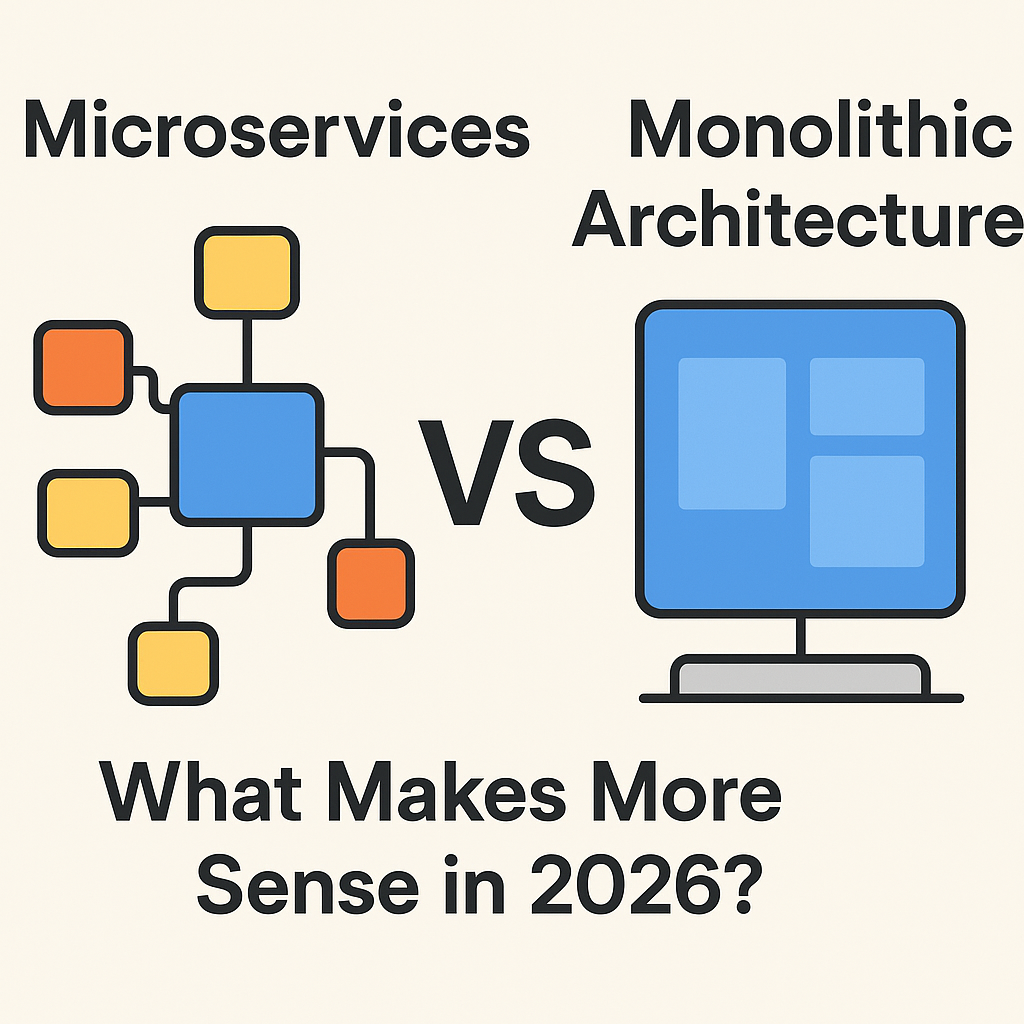
Microservices vs. Monolithic Architecture: What Makes More Sense in 2026?


Microservices vs. Monolithic Architecture: What Makes More Sense in 2026?

In 2026, the software world is still debating a classic question: should you build with microservices or stick with a monolithic architecture? If you’ve read the last decade of engineering blogs, you’ve probably noticed that both sides make compelling arguments. Microservices promise speed, flexibility, and independent scaling. Monoliths offer simplicity, fewer moving parts, and faster early development. But the truth is: the “right” architecture isn’t a slogan—it’s a decision shaped by your team size, delivery speed, operational maturity, regulatory constraints, data complexity, and product roadmap. In 2026, technology has shifted too. Containerization is mature, cloud platforms are more forgiving, observability tooling is better than ever, and platform engineering has become a real discipline. At the same time, operational costs, governance needs, and team overhead have not disappeared. So the most useful answer is not “microservices are better” or “monoliths win.” Instead, it’s: what choice makes sense for your context in 2026?

The Definitions: What We’re Actually Comparing

Before choosing, it helps to define the terms clearly:

Monolithic Architecture

A monolith is a single application deployed as one unit. It may be organized internally into modules (for example, billing, catalog, user management), but it typically shares a single runtime, build pipeline, and database strategy (often one primary database).

Microservices Architecture

Microservices break the system into smaller services, each with a clear responsibility. Services are deployed independently and communicate via APIs, events, or both. Each service typically owns its data (at least logically), and failures are isolated by design. In practice, “microservices” doesn’t always mean “hundreds of services.” Some companies run a small set of services or adopt a modular monolith that gradually evolves into finer granularity. The spectrum matters.

Why This Question Matters More in 2026

In 2026, architecture choices have long-tail consequences. You don’t just decide how to build—you decide how to: • Ship product features (and how quickly)
• Scale reliably under real traffic spikes
• Debug and trace production issues
• Control costs (compute, networking, storage, and engineering time)
• Comply with security and governance requirements
• Onboard developers and reduce cognitive load
Architecture is also increasingly “cost-aware.” Microservices can optimize scaling and reliability, but they can also multiply operational overhead. Meanwhile, monoliths can reduce operational complexity, but they may become bottlenecks if teams outgrow shared codebases.

Microservices in 2026: Strengths That Still Hold

Microservices remain a strong option when your organization has (or is willing to build) the capabilities required to operate them. Here are key advantages that are especially relevant today:

1) Independent Scaling for Hotspots

In many modern systems, not all components experience traffic uniformly. Authentication, search, recommendations, payments, and reporting can have different load patterns. With microservices, you can scale the service that’s hot without scaling everything else.

2) Independent Deployment and Faster Delivery

Microservices can enable teams to ship changes without coordinating release trains across a huge codebase. When done well, this reduces lead time and makes A/B testing and experimentation easier.

3) Isolation Improves Reliability (When Coupled with Good Design)

Failures can be contained. If you use circuit breakers, timeouts, retries with backoff, and graceful degradation, one service’s failure doesn’t necessarily cascade into an outage.

4) Clear Ownership and Team Alignment

When each team owns a service, it can reduce ambiguity about responsibilities. Ownership can improve accountability and help teams evolve features within their domain.

5) Better Fit for Complex Ecosystems

If you’re integrating with external partners, building a platform for other teams, or consuming many third-party APIs, microservices can compartmentalize integration logic and reduce the risk of cross-cutting changes.

But Microservices Come with Costs (Even in 2026)

The downside of microservices isn’t just “it’s complicated.” In 2026, the main issues are operational, organizational, and architectural. Common challenges include:

1) Operational Overhead

More services mean more instances, deployments, logs, metrics, and alert rules. You need CI/CD maturity, runtime governance, and reliable service discovery.

2) Distributed System Complexity

Latency, network failures, partial outages, retries, idempotency, and eventual consistency become everyday realities. Debugging is harder than in monoliths because the request path crosses multiple boundaries.

3) Data Consistency and Transactions

Keeping data consistent across services is challenging. You might use sagas, event sourcing, or careful boundary design. But “just add microservices” doesn’t automatically solve data modeling problems—it changes them.

4) Versioning and Contract Management

APIs between services require versioning strategies and contract testing. Without these, you can end up with brittle integrations and a “dependency nightmare.”

5) Architecture Drift

If microservices aren’t governed well, you can end up with inconsistent patterns, duplicated functionality, and unclear service boundaries. In 2026, platform engineering helps, but it still requires time and leadership.

Monolithic Architecture in 2026: Why Simplicity Still Wins

Despite years of hype, monoliths never truly disappeared. In many cases, they’re still the best starting point—especially when reliability and speed of iteration matter more than granular scaling.

1) Faster Development and Lower Complexity Early On

A well-structured monolith typically has fewer integration points. Engineers can refactor and test features locally without juggling service boundaries.

2) Simpler Testing and Debugging

Because many operations stay in one process, end-to-end debugging can be dramatically easier. You can write more comprehensive integration tests without needing complex test environments for dozens of services.

3) Stronger Consistency Options

In monoliths, it’s easier to use database transactions and keep data consistent. If your business logic depends on strict consistency (for example, certain financial workflows), a monolith can reduce risk.

4) Lower DevOps and Infrastructure Burden

You may still need production-grade operations, but you avoid many “distributed system tax” costs: service-to-service networking, contract versioning, and cross-service tracing complexity.

5) Great for Product-Market Fit

Startups and fast-moving teams benefit from reducing architecture decision fatigue. A modular monolith can scale with you while preserving delivery speed.

The Monolith Risks in 2026 (And How to Mitigate Them)

Monoliths aren’t automatically better. In fact, many monoliths fail for predictable reasons:

1) The “Big Ball of Mud” Problem

If you don’t enforce modular boundaries, the codebase becomes tangled. Refactoring slows down, releases become risky, and new features take longer than expected.

2) Scaling Bottlenecks

If one part of the monolith is under heavy load, you may need to scale the whole application. That can increase compute cost.

3) Team Concurrency Issues

Shared repositories and shared release cycles can lead to merge conflicts and coordination overhead when the team grows.

4) Limited Deployment Independence

If every change requires redeploying the entire application, you lose some of the speed benefits that microservices can offer. The good news: modern best practices can mitigate these risks. Think modular monolith design, strict interfaces, clear domain boundaries, and disciplined CI/CD.

A Realistic 2026 Strategy: The Spectrum Approach

One of the biggest lessons of the past few years is that architecture is not binary. In 2026, a common winning strategy is to choose somewhere along the spectrum:

Start with a Modular Monolith

Many teams begin with a monolith but enforce boundaries internally—clean architecture, domain-driven design (DDD), or hexagonal architecture patterns. The goal: maintain modularity now so you can split later without chaos.

Extract Microservices Gradually

You typically extract services when you have: • Clear domain boundaries
• Measurable scaling or reliability needs
• Team capacity to own services end-to-end
• A proven operational foundation (observability, deployment automation)
• A data strategy that won’t create unmanageable consistency problems

Use Microservices Selectively

Not every domain needs microservices. Sometimes the best answer is to keep most logic in a monolith while extracting only the components that truly benefit—like search, notifications, reporting, or integrations.

Technology Trends in 2026 That Influence the Choice

Architecture decisions don’t happen in a vacuum. Here are practical 2026 factors that shift the balance.

1) Observability Has Improved

Distributed tracing, structured logging, and better metrics pipelines reduce the pain of debugging microservices. Teams that invest in observability can mitigate one of the biggest microservices drawbacks.

2) Platform Engineering Is Now Mainstream

Organizations increasingly build internal platforms: standardized deployment templates, service scaffolding, security baselines, and consistent CI/CD. This reduces microservice “reinvention” and governance overhead.

3) Cloud Managed Services Help (But Don’t Eliminate Complexity)

Managed databases, message queues, API gateways, and serverless components can accelerate microservices implementation. However, they also introduce vendor-specific constraints and new failure modes.

4) Cost Awareness Is Higher

Microservices can increase network traffic, storage duplication, and operational costs. In 2026, teams are more likely to simulate costs, monitor unit economics, and optimize architecture rather than assume scaling is “free.”

5) AI-Assisted Development Changes Team Throughput

AI tools can speed up coding and testing, but they don’t replace architecture judgment. In fact, faster code generation can tempt teams to create unnecessary service boundaries. Architecture discipline still matters.

Decision Framework: Which Architecture Makes More Sense for You?

Use this practical checklist to decide what makes more sense in 2026.

Choose a Modular Monolith (or Keep One) If…

• Your product roadmap is still evolving and you need fast iteration
• Your team is small to mid-sized
• You want simpler debugging and testing
• You need strong transactional consistency
• You haven’t yet built platform/DevOps maturity for distributed systems

Move Toward Microservices If…

• You have multiple teams with clear domain ownership
• You need independent scaling for distinct workloads
• Reliability requirements demand isolation
• You can invest in observability, CI/CD, and contract governance
• The system is complex enough that modular boundaries inside a monolith would still become limiting

A Middle Path That’s Often Best

In many 2026 organizations, the best answer is: build a modular monolith first, then extract microservices only where they provide measurable value.

Common Mistakes to Avoid

No matter your choice, avoid these pitfalls:

Mistake 1: Splitting Microservices Without Domain Clarity

If boundaries are arbitrary, you’ll end up with chatty services and duplicated business logic.

Mistake 2: Assuming Microservices Automatically Improve Scalability

Bad caching, slow database queries, and inefficient messaging can still make microservices slow. Microservices don’t remove performance engineering—they change where it applies.

Mistake 3: Letting the Monolith Become Untestable

If your monolith lacks good testing boundaries, every change becomes risky and releases slow down.

Mistake 4: Neglecting Security and Governance

In microservices, security must be consistent across service boundaries. In monoliths, security must be enforced carefully to prevent cross-module privilege leaks.

Conclusion: What Makes More Sense in 2026?

So, microservices or monoliths—what makes more sense in 2026? The best answer is context-driven, and the winning strategy is often modular design with a deliberate evolution path. If you’re building a new product or you need maximum delivery speed, a modular monolith is frequently the safest and most efficient starting point. If your organization has multiple teams, clear domain ownership, and the operational maturity to handle distributed systems, microservices can provide powerful benefits—especially for independent scaling and reliability. In 2026, the smartest architects aren’t choosing a religion. They’re choosing an approach that supports their team’s reality today while keeping the door open for tomorrow’s complexity. Final takeaway: Build what you can operate well. Optimize for the constraints you actually have—then evolve your architecture as those constraints change.

FAQ

Is microservices always better than a monolith?

No. Microservices can be better for large organizations with strong platform maturity and clear domain boundaries, but monoliths often outperform early on due to simplicity, faster testing, and fewer operational dependencies.

Will microservices be required in 2026?

No. Many successful systems remain monolithic or modular monolithic. The question is whether your workloads, team structure, and reliability needs justify distributed complexity.

What’s the best compromise architecture?

A modular monolith is the most common compromise: keep a single deployable unit while enforcing internal boundaries, then extract microservices selectively when specific domains demand it.

How do we know when to extract services?

Look for measurable drivers: scaling hotspots, frequent independent releases, reliability isolation needs, or clear ownership boundaries that reduce team friction. If you’d like, tell me what kind of product you’re building (startup vs enterprise, team size, expected traffic patterns, and regulatory requirements), and I can recommend an architecture approach tailored to your scenario.