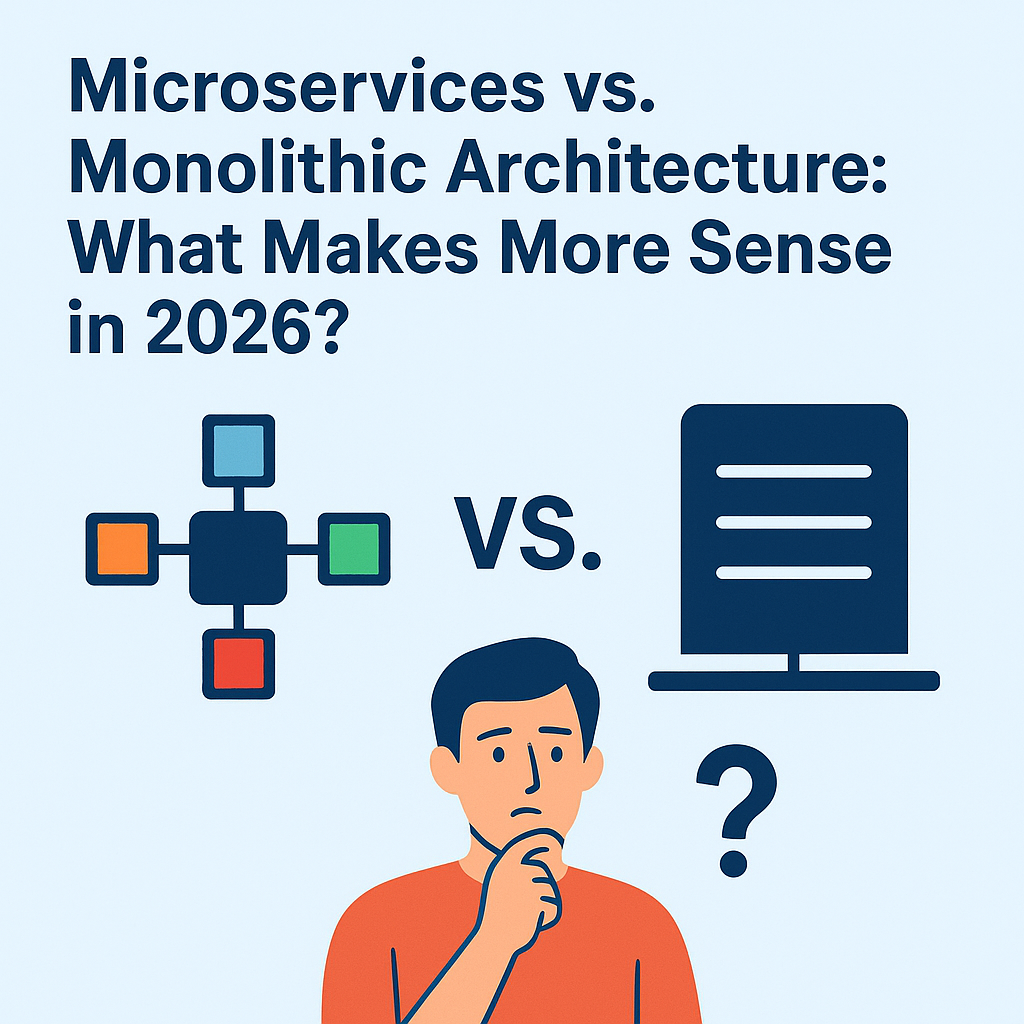
Microservices vs. Monolithic Architecture: What Makes More Sense in 2026?
MaxTech Online
Microservices vs. Monolithic Architecture: What Makes More Sense in 2026?
In 2026, the architecture debate between microservices and monolithic systems isn’t as simple as “microservices are modern” or “monoliths are outdated.” The truth is more nuanced: both approaches can build fast, reliable, and scalable software—depending on your business goals, team structure, operational maturity, and constraints. This article breaks down what matters in 2026, what’s changed since the early microservices hype cycle, and how to choose an architecture that will still make sense a few years from now.
Quick Definitions (So We’re Talking About the Same Thing)
A monolithic architecture is a single deployable application where components interact internally (often through in-process calls). While monoliths can still be modular—using layers, packages, or clean boundaries—they typically deploy as one unit.A microservices architecture breaks the system into smaller services, each deployable independently and communicating over network protocols (e.g., HTTP/REST, gRPC, messaging). Each service generally owns its data and behavior.In 2026, you’ll also hear “modular monolith” and “microservices-lite.” These are not just buzzwords—they’re real strategies to reduce complexity while keeping the benefits teams want.
What Changed Since the Microservices Boom?
During the early 2010s, many organizations adopted microservices expecting instant improvements in scalability and delivery speed. However, many ran into common problems: complex deployments, distributed tracing gaps, duplicated effort across teams, and operational overhead.By 2026, the ecosystem has matured. Tooling for observability, service discovery, configuration management, and deployment automation is far more capable. Cloud platforms are more standardized. Container orchestration is less experimental. Even so, microservices still introduce fundamental complexity that you can’t “tool away” completely.
Core Trade-Offs: The Decision Points That Actually Matter
1) Deployment Independence vs. Deployment Simplicity
Microservices: You can deploy a single service without redeploying the entire system. This can accelerate delivery, especially when teams work independently and change rates vary by domain.Monolith: Every change typically rolls out as one deployment unit. With proper CI/CD and incremental releases, this can still be efficient—especially if your system isn’t changing constantly across many teams.In 2026: Many teams use feature flags, canary releases, and strong automated testing to make monolithic deployments far less risky than they used to be.
2) Operational Overhead and Team Maturity
Microservices require mature operations: monitoring, alerting, incident response, chaos testing, capacity planning, dependency management, and security at the service boundary. In practice, you often need more engineering support across DevOps/SRE and platform engineering.Monoliths reduce moving parts. That doesn’t remove operational work, but it usually makes the learning curve and day-to-day maintenance simpler—particularly for smaller teams.In 2026: Organizations are more aware of the “hidden tax” of microservices. If your team is still building internal platform capabilities, a monolith (or modular monolith) may be the safer foundation.
3) Data Management: The Real Hard Part
Microservices often encourage each service to own its database. This can improve autonomy, but it creates new challenges: cross-service queries, reporting, data consistency, and eventual consistency semantics.Monoliths make data consistency easier. A single database (or unified data layer) simplifies transactions and complex joins.In 2026: Many teams use event-driven patterns and CDC (change data capture), but you still need a strategy for data modeling, event schemas, and versioning. If you can’t commit to this discipline, microservices can become painful.
4) Performance and Latency
Monoliths generally avoid network hops. Function calls are cheaper than HTTP/gRPC calls. Microservices add latency through inter-service communication, plus the overhead of retries and timeouts.In 2026: This is less of a problem than it used to be thanks to gRPC, service mesh efficiencies, and better caching. Still, if your system depends on chatty interactions, the architecture can impact cost and responsiveness.
5) Reliability, Failure Modes, and “Distributed Systems Reality”
Microservices turn one system into many failure-prone components. Network partitions, partial outages, and cascading failures require defensive engineering: circuit breakers, bulkheads, idempotency, and robust retries.Monoliths also fail, but the failure surface is narrower. Debugging is often easier because everything runs in one process space or at least one deployable boundary.In 2026: Reliability engineering is standard practice. But microservices demand it more intensely. If you don’t already have incident response maturity, monoliths may be the better starting point.
Microservices in 2026: Where They Still Shine
Microservices can be an excellent choice when you have specific conditions:
Multiple teams working on different domains with different change cadences.
Clear business boundaries (e.g., payments, identity, catalog, fulfillment) that align with service ownership.
Independent scaling needs (one part of the system needs more compute than another).
Different technology stacks per domain (when justified, not as an excuse for inconsistency).
A strong platform capability (CI/CD automation, observability, security patterns, and standardized tooling).
Additionally, microservices are useful when your organization wants to evolve parts of the system without coordinating a full-scale release. In mature organizations, that can create meaningful business agility.
Monolithic Architecture in 2026: Still a Winning Option
A monolith is not “bad.” In 2026, it can be highly strategic—especially when paired with modular boundaries.Monoliths tend to excel when:
You have a smaller team or fewer teams coordinating.
Your product is early to mid-stage and priorities shift often.
You want faster development with fewer operational constraints.
You need strong consistency and simpler data interactions.
You want to establish engineering foundations before distributing complexity.
A modular monolith is a common best-of-both-worlds approach: keep deployment simple like a monolith, but structure the codebase so that modules could become services later. This helps you avoid rewriting everything when you finally decide to split.
The “Modular Monolith → Microservices” Path: A Practical Strategy
Many teams in 2026 choose an evolutionary approach:
Start with a modular monolith while you learn your domain and build internal tooling.
Enforce boundaries through clear interfaces, ownership, and dependency rules.
Extract services gradually only when there’s a clear reason (scaling, team ownership, failure isolation, or technology constraints).
This reduces the “big bang” risk. Instead of committing to microservices from day one, you split based on real evidence.
What About “Microservices But Simpler”?
In 2026, you’ll see variations that reduce complexity: fewer services, larger service granularity, or shared infrastructure layers. Some organizations use “microservices-lite,” where they separate deployable units but limit the number of cross-service interactions.The key is to avoid distributing complexity without reason. If you split too early or fragment too much, you end up with a system that is harder to run than it needs to be.
Security Considerations: Don’t Ignore Them
Security is a major factor in 2026 architecture decisions.
Microservices: More service boundaries mean more authentication/authorization checks, more secrets management, and a larger attack surface if not handled consistently.
Monolith: Fewer boundaries can simplify security enforcement, though you must still design properly (least privilege, secure session handling, and input validation).
In modern stacks, identity solutions and service-to-service authentication (like mTLS) help, but the workload is still higher for microservices.
Observability: The Make-or-Break Capability
Whether you choose microservices or monolith, you’ll want strong observability. In microservices, this is non-negotiable.Look for:
Distributed tracing (critical for microservices)
Structured logging with correlation IDs
Metrics for latency, error rates, and saturation
Alerting tied to business outcomes, not just technical thresholds
In monoliths, you can often get great results with simpler instrumentation, though correlating requests across modules is still important.
Cost in 2026: More Than Just Infrastructure
Architecture affects cost in multiple ways:
Compute and network (microservices can increase network chatter and repeated serialization/deserialization).
Operational labor (more services require more monitoring and faster incident response).
Tooling and platform engineering (especially for microservices).
Developer productivity (teams can move faster with independence—or slower due to integration complexity).
In 2026, teams are better at estimating these trade-offs. The best choice is often the one that meets performance and reliability goals without wasting engineering time.
A Decision Framework: How to Choose in 2026
Here’s a practical checklist you can use:
Choose Microservices If…
You have multiple teams and clear domain boundaries.
You need independent scaling and independent deployment.
You can invest in observability, automation, and reliability engineering.
Your data and integration strategy is well thought out (events, versioning, consistency model).
Choose a Monolith (Modular Monolith Preferred) If…
You want faster development with fewer operational dependencies.
Your system still evolves rapidly and your boundaries aren’t stable yet.
You need simpler transactions or cross-domain queries.
You don’t yet have strong platform engineering or SRE coverage.
Choose “Hybrid” If…
You want a monolith for most domains, but extract a few high-value services.
You’re migrating gradually and want risk reduction.
You’re optimizing for business outcomes rather than ideology.
Common Mistakes to Avoid (Regardless of Architecture)
Whatever you pick, avoid these traps:
Splitting too early without real domain boundaries or operational readiness.
Creating microservices with shared databases that destroy autonomy and increase coupling.
Ignoring integration testing and relying only on unit tests.
Underinvesting in observability and security.
Allowing architecture to become a religion instead of a tool for business results.
What “Makes More Sense” in 2026?
So, what makes more sense in 2026? The honest answer is: the architecture that matches your constraints and your ability to operate it well.In many real-world organizations, a modular monolith is the strongest default starting point. It’s easier to build, easier to observe initially, and less risky. Then, as the organization matures and the product stabilizes, services can be extracted where it truly pays off.Microservices make more sense when you’re large enough, mature enough, and structured enough to handle distributed complexity—while also needing the benefits: independent deployment, team autonomy, selective scaling, and better isolation of failure domains.
Final Thoughts: Build for the Next 3–5 Years
Architecture decisions aren’t permanent, but rewrites are expensive. In 2026, the best strategy is to optimize for learning, reliability, and sustainable delivery. Use modular boundaries, automate what you can, and choose microservices only when there’s a clear business and technical reason.If you start with a modular monolith and evolve intelligently, you’ll stay flexible. If you choose microservices, commit to platform maturity, observability, and disciplined data/integration practices. Either way, the winner is the approach that your team can build, run, and improve—reliably—at scale.Want a follow-up? I can also help you add a “TL;DR” section, a comparison table (monolith vs microservices), and an FAQ section optimized for SEO and AdSense-friendly readability.