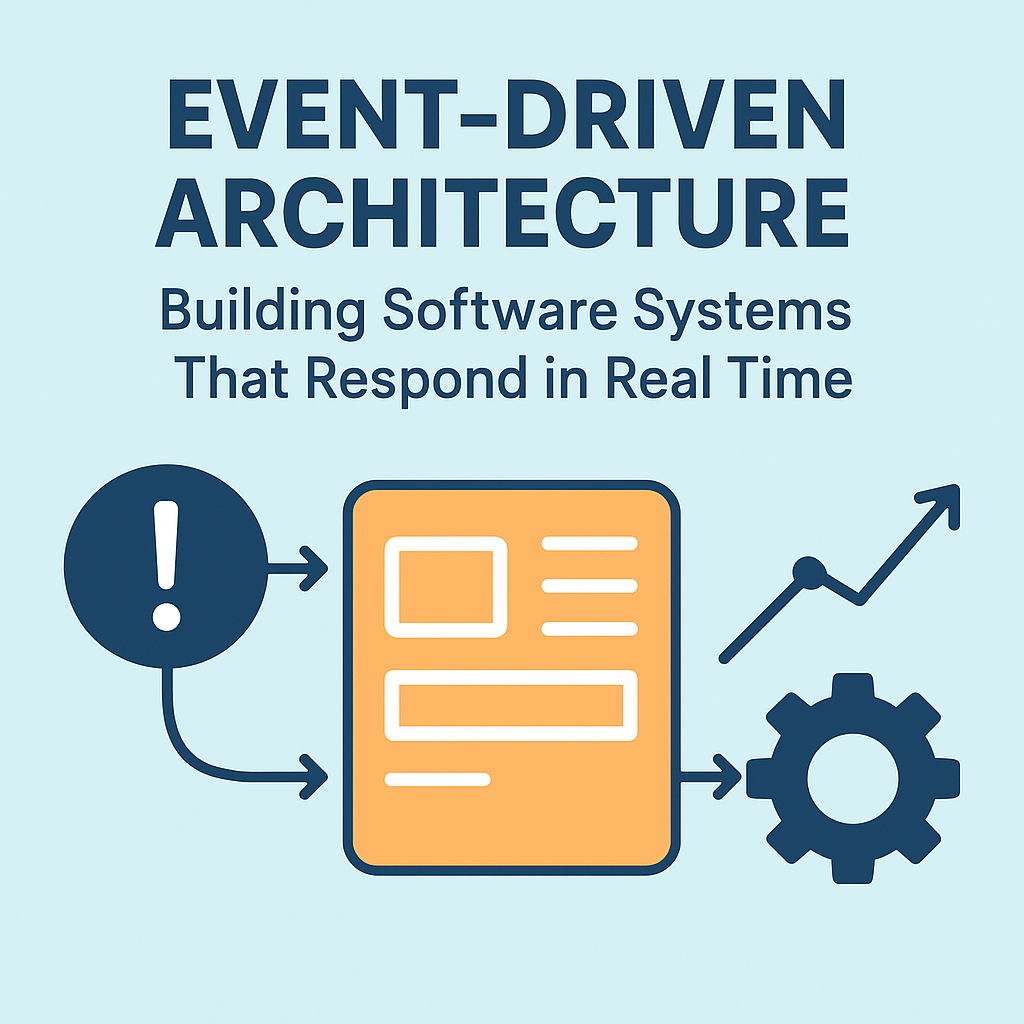
Event-Driven Architecture: Building Software Systems That Respond in Real Time

Event-Driven Architecture: Building Software Systems That Respond in Real Time

Real-time experiences aren’t a luxury anymore—they’re the baseline. Whether it’s a ride arriving on a map instantly, a fraud alert triggering within seconds, a chat message appearing instantly, or an inventory update reflecting across multiple services without delay, users expect software to react immediately. That’s where Event-Driven Architecture (EDA) comes in. In this post, we’ll explore what event-driven architecture is, why it’s so effective for real-time systems, how to design it responsibly, and how to avoid the common pitfalls that can turn “real-time” into “mysterious delays.” By the end, you’ll have a clear blueprint for building systems that respond quickly, scale smoothly, and remain resilient as complexity grows.

What Is Event-Driven Architecture?

An event is a meaningful change in state within your system—something that happened and is worth notifying others about. Examples include:
  • OrderPlaced
  • UserSignedUp
  • PaymentCaptured
  • TemperatureThresholdExceeded
  • DeviceWentOffline
In event-driven architecture, components don’t typically call each other directly. Instead, they publish events when something occurs, and other components subscribe to the events they care about. Instead of a rigid sequence like “Service A calls Service B, which calls Service C,” EDA allows systems to behave more like a coordinated team of specialists: when something important happens, the right listeners spring into action.

Why Event-Driven Systems Feel “Real Time”

Real-time responsiveness is less about “milliseconds” alone and more about how quickly information flows through your system. Event-driven architecture supports real-time behavior because:
  • Asynchronous communication: Publishers don’t wait for subscribers to finish, so the system avoids bottlenecks.
  • Decoupling: Services evolve independently; changes in one component don’t force others to be rewritten.
  • Near-instant propagation: When an event is emitted, subscribers can react immediately using a queue or streaming pipeline.
  • Parallel processing: Multiple subscribers can handle the same event concurrently.
In short, EDA turns “waiting for a response” into “reacting to a fact that just occurred.” That mental model maps perfectly to user expectations.

Key Building Blocks of Event-Driven Architecture

To design an event-driven system, you’ll typically use a combination of these concepts:

1) Event Producers

These are components that detect changes and emit events. For example, an API service might publish an OrderPlaced event once a checkout completes.

2) Event Consumers

Consumers listen for specific events and execute business logic. For instance, a fulfillment service might consume OrderPlaced and start picking items.

3) Event Transport (Message Brokers / Streaming Platforms)

Events usually travel through a middleware layer such as:
  • Message brokers (e.g., RabbitMQ, ActiveMQ)
  • Streaming platforms (e.g., Apache Kafka, Pulsar)
These tools provide buffering, persistence, delivery semantics, and scaling features that make real-time reaction reliable—even under load.

4) Event Schemas

Events should be structured and validated. Tools like JSON Schema, Avro, Protobuf, or similar schema registries help ensure producers and consumers agree on what an event looks like.

5) Observability

Real-time systems can fail in subtle ways. Good architecture includes logging, metrics, tracing, and event-specific monitoring so you can detect lag, errors, and throughput issues early.

Different Styles of Event-Driven Architecture

“Event-driven” can mean several patterns. Knowing the differences helps you choose the right approach.

Publish/Subscribe (Pub/Sub)

Producers publish events to a topic, and consumers subscribe to those topics. This model is common for decoupled communication.

Command + Event (CQRS-Friendly)

Many systems separate commands (intents like “PlaceOrder”) from events (facts like “OrderPlaced”). This is a natural fit for CQRS (Command Query Responsibility Segregation), where reads and writes can be optimized independently.

Event-Carried State Transfer (Sometimes)

In some cases, consumers need enough data to avoid extra lookups. Events can carry relevant payload information. But be careful: including too much state can bloat events and cause tight coupling.

Designing for Real-Time Responsiveness

EDA can provide real-time behavior, but only if you design thoughtfully. Here are practical considerations that make a measurable difference.

Keep Events Small and Focused

Events should contain the data consumers need to react. If you include large blobs or deeply nested structures, performance suffers and schema evolution becomes harder. Tip: Send identifiers (e.g., orderId, userId) and include key metadata (timestamps, correlation IDs). Let consumers fetch additional details only when needed.

Use Correlation IDs for End-to-End Traceability

Real-time systems are distributed by nature. Without correlation IDs, debugging becomes guesswork. A correlation ID links the chain of events and actions spawned from a single user request.

Choose Appropriate Delivery Semantics

Message delivery can be:
  • At-most-once (may drop events; fast but risky for critical workflows)
  • At-least-once (retries possible; duplicates may occur)
  • Exactly-once (harder in practice; often approximated)
For many business systems, at-least-once is common. If duplicates can happen, then your consumers should be idempotent (able to process the same event multiple times without incorrect results).

Idempotency: The Secret Weapon for Reliable Real Time

Real-time architectures frequently deal with retries. Networks fail, consumer services restart, and transient errors occur. If the system reprocesses an event, it should not corrupt state. Idempotent consumer example:
  • When an event arrives, check whether it has already been processed using an event ID.
  • If yes, skip the action.
  • If no, perform the action and record the processed ID.
This pattern prevents double-charging, duplicate shipments, and inconsistent read models—especially important in systems reacting instantly to events.

Handling Backpressure and Event Storms

“Real time” doesn’t mean “ignore overload.” If a burst of events floods your system, you need strategies to handle backpressure.

Scale Consumers Horizontally

Most event systems allow multiple consumer instances. Partitioning (e.g., in Kafka) can ensure ordering guarantees per key while still scaling throughput.

Throttle or Defer Non-Critical Work

Not every subscriber needs to act at exactly the same urgency. You can separate consumers into tiers: critical real-time reactions vs. eventual consistency tasks (like analytics indexing).

Set and Monitor Consumer Lag

Consumer lag tells you how far behind subscribers are. When lag grows, it’s often an early warning signal that something is wrong—like slow downstream dependencies or insufficient partitions.

Event Versioning Without Breaking Everything

As your product evolves, event definitions change. Without a versioning strategy, old consumers break or, worse, start misinterpreting events. Good event-driven design includes:
  • Backward compatibility: Add fields in a way existing consumers can ignore.
  • Versioned schemas: Use schema evolution tools or explicit event version fields.
  • Deprecation policies: Plan how long you support old event formats.
The goal is to enable continuous delivery while keeping the event ecosystem stable.

Building Event-Driven Systems: A Practical Workflow

If you’re planning to build an event-driven architecture, here’s a practical workflow you can adapt.

Step 1: Identify Domain Events

Start with business outcomes and user-visible changes. What “facts” happen in your domain that other parts of the system should know about?

Step 2: Map Consumers to Events

For each event, list who consumes it and what they do. If no one cares yet, consider whether it’s premature to emit the event.

Step 3: Define Event Contracts (Schemas)

Create an event contract for each event type. Keep it stable, version it intentionally, and validate it in CI/CD pipelines.

Step 4: Implement Publishing and Subscribing

Build producers and consumers with clear error handling. Make sure consumers can retry safely and remain idempotent.

Step 5: Add Observability from Day One

Track:
  • Event publish rates
  • Consumer processing time
  • Error counts and dead-letter queue (DLQ) usage
  • Consumer lag

Step 6: Test with Realistic Load

Real-time systems behave differently under load. Run load tests that produce bursts of events, simulate consumer restarts, and verify system behavior.

Common Pitfalls (And How to Avoid Them)

Event-driven architecture can be incredibly effective, but it’s not automatic success. Watch out for these classic mistakes:

Pitfall 1: Treating Events Like Direct Calls

Events should not be used as a replacement for synchronous request/response logic. If you need immediate responses, consider command patterns or query mechanisms.

Pitfall 2: Spaghetti Event Dependencies

If too many teams subscribe to everything, you can end up with hidden coupling through the event fabric. Document events, set ownership, and apply governance.

Pitfall 3: No Dead-Letter Strategy

When events fail repeatedly, what happens? A DLQ (dead-letter queue) captures problematic messages so you can inspect, replay, and fix issues without losing data.

Pitfall 4: Ignoring Backward Compatibility

Breaking changes in event payloads can cause consumer outages. Use schemas, versioning, and compatibility testing.

Where Event-Driven Architecture Shines

EDA is particularly valuable in scenarios where:
  • Real-time updates matter (notifications, live dashboards, collaboration tools)
  • Multiple systems must react (billing, inventory, analytics, risk scoring)
  • Loose coupling is essential (microservices, multi-team platforms)
  • Workloads are bursty (seasonal traffic, event spikes)
It’s a strong fit for modern cloud-native systems because it supports independent scaling and resilient failure handling.

The Future of Real-Time Systems: More Streams, More Intelligence

As teams adopt streaming and event-driven approaches, the ecosystem keeps expanding:
  • Streaming analytics for real-time insights
  • AI-driven anomaly detection that reacts to patterns in event streams
  • Operational intelligence using observability data turned into alerts automatically
  • Event-based workflows that coordinate long-running processes
With these capabilities, event-driven architecture becomes more than a communication style—it becomes the foundation for responsive, intelligent systems that continuously learn from what’s happening right now.

Conclusion: Build for Reaction, Not Just Execution

Event-Driven Architecture is a powerful way to build software systems that respond in real time. By modeling meaningful changes as events, decoupling producers from consumers, and using reliable messaging infrastructure, you can create systems that scale, recover gracefully, and deliver fast user experiences. The best part? EDA doesn’t just help you “go faster.” It helps you design software that remains flexible as your product evolves—because your system reacts to facts, not rigid call chains. If you’re planning your next system—whether it’s a live notifications platform, a supply chain orchestrator, or a fraud detection pipeline—consider building it event-driven from the start. With the right schema contracts, idempotent consumers, and observability, “real time” becomes a repeatable engineering outcome rather than a hard-won miracle. Want to go deeper? Next, you could explore schema registries, exactly-once processing strategies, DLQ replay workflows, and event-driven testing techniques like contract testing and end-to-end replay.