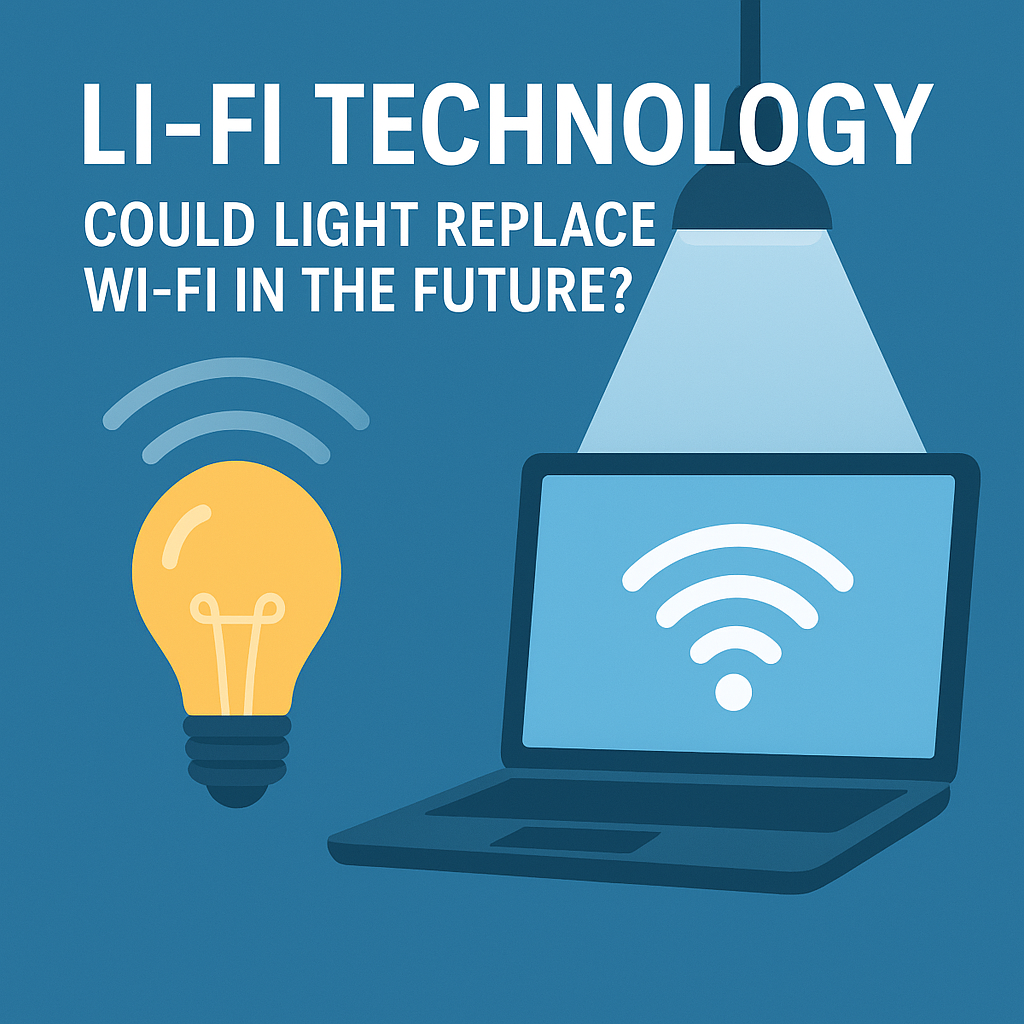
Li-Fi Technology: Could Light Replace Wi-Fi in the Future?

Li-Fi Technology: Could Light Replace Wi-Fi in the Future?

Every day, we rely on Wi‑Fi to stream videos, download apps, join video calls, and power smart homes. But as more devices connect—and as data-hungry technologies like AR/VR and high-resolution streaming become mainstream—the limits of traditional wireless networks are becoming harder to ignore. That’s where a promising technology steps in: Li‑Fi (Light Fidelity). Li‑Fi uses light instead of radio waves to transmit data, potentially offering faster speeds, improved security, and new ways to connect devices—especially in environments where Wi‑Fi is limited or where interference is a concern. So, could light truly replace Wi‑Fi in the future? The answer is: it could partially replace it in some scenarios, but a full global replacement is unlikely in the near term. What’s more realistic is a hybrid future where Li‑Fi and Wi‑Fi (and other wireless technologies) work together, each playing to its strengths. Let’s explore how Li‑Fi works, what makes it exciting, the challenges it faces, and where it could realistically shine.

What Is Li‑Fi?

Li‑Fi stands for “Light Fidelity.” It refers to a family of technologies that transmit data using visible light (and sometimes infrared light) from LEDs. Instead of sending data through radio frequencies like Wi‑Fi, Li‑Fi “encodes” information into light signals—often by rapidly turning LEDs on and off or by modulating the intensity of the light. A compatible receiver (like a photodiode or camera-based sensor) captures these changes and converts them back into data. Importantly, Li‑Fi is not just “faster lighting.” It’s a communication method. LEDs are already widely used in homes, offices, street lamps, and industrial spaces. If those lights can also carry data, then everyday illumination could become part of your network.

How Li‑Fi Works (In Plain Language)

Li‑Fi generally relies on one of two approaches: visible light communication (VLC) using LEDs, or infrared communication using IR emitters. Most public discussion focuses on VLC, especially with white light LEDs. Here’s the typical flow: 1) Data is turned into light signals: A transmitter takes digital data and modulates it—changing the brightness or switching patterns of an LED quickly. 2) The receiver captures the light changes: A photodetector (or specialized sensor) receives the varying light intensity. 3) The receiver decodes the data: Signal processing converts the light modulation back into usable data. The key concept is modulation. The human eye perceives light as constant, but LEDs can switch and adjust brightness at extremely high speeds—fast enough to carry data while remaining invisible to us.

Why Light Could Outperform Wi‑Fi

Li‑Fi is often compared to Wi‑Fi, and for good reason. Both are wireless technologies, but they use different “spectrums.” Wi‑Fi uses radio waves, while Li‑Fi uses light. Each has unique advantages.

1) Potential for Higher Bandwidth

Visible light offers a massive amount of “unused bandwidth” compared to radio spectrum. While radio bands are regulated and limited, the light spectrum available for communication—especially with LED lighting—is far broader. That doesn’t automatically guarantee infinite speeds, but it opens exciting possibilities for high-capacity networks.

2) More Secure by Design

Li‑Fi signals do not travel easily through walls the way many radio signals do. That can make eavesdropping harder because the connection is more line-of-sight or requires light paths. In security-conscious environments—like offices, hospitals, or data centers—this physical limitation can be a major advantage. However, no technology is magically secure. Advanced attackers can still attempt various methods (such as capturing signals in reachable spaces). Still, Li‑Fi can reduce risk compared to widely broadcast radio transmissions.

3) Reduced Radio Interference

In crowded urban areas, radio interference from countless Wi‑Fi networks and mobile devices is a real problem. Li‑Fi can operate in the lighting domain, reducing competition for radio channels. This could be especially useful in places where radio communication is constrained or where interference is critical.

4) Big Gains in Specific Industries

Some environments are tricky for Wi‑Fi: hospitals with sensitive equipment, industrial sites with heavy electromagnetic noise, aircraft cabins, and certain secure facilities. Li‑Fi can complement existing networks and improve reliability in settings where radio spectrum is limited.

Where Li‑Fi Could Be Used First

If Li‑Fi has a future, it will likely arrive gradually—first in targeted use cases rather than replacing Wi‑Fi everywhere overnight. Here are some promising early deployment scenarios.

Smart Buildings and Offices

Buildings already have LED lighting. If that lighting becomes “networked,” each room or even each light fixture can provide localized high-speed connectivity. Employees could connect securely without relying heavily on Wi‑Fi, and administrators could manage network access more granularly.

Hospitals and Healthcare Facilities

Healthcare settings require stable connectivity for systems like patient monitoring, imaging workflows, and secure communications. Li‑Fi’s reduced interference could help, particularly when Wi‑Fi conditions are difficult.

Warehouses and Industrial Environments

Warehouses and factories can suffer from signal obstruction, reflections, and interference from machinery. Li‑Fi could be installed through industrial lighting systems, creating controlled data zones.

Transport and Smart Mobility

In vehicles, ships, or trains, radio connectivity can be unpredictable. Li‑Fi could potentially deliver in-cabin communications or platform hotspots for passengers. It’s also conceivable for “roadside communication” using street lighting.

Airports, Libraries, and Public Venues

High-traffic locations need networks that handle many connections at once. Li‑Fi could create dense capacity in specific areas—especially if the lighting infrastructure is already in place.

Could Li‑Fi Replace Wi‑Fi Entirely?

Replacing Wi‑Fi completely is a tough sell for several reasons.

1) Light Obstacles and Mobility Challenges

Li‑Fi’s performance often depends on the availability of light paths. If a user moves behind an obstruction, the connection can weaken. Wi‑Fi is more forgiving because radio waves can penetrate and reflect through many surfaces better than light. That said, modern Li‑Fi systems can use multiple light sources and advanced handover techniques—meaning mobility isn’t impossible. But the user experience may differ from conventional Wi‑Fi.

2) Infrastructure and Device Adoption

To use Li‑Fi widely, devices must include compatible receivers (such as photodiodes) or support camera-based decoding methods. That requires hardware changes. In the short term, early adoption will likely rely on accessories, specialized devices, or gateway systems.

3) Environmental Factors

Lighting conditions matter. For example, bright sunlight or flickering lighting can affect communication quality depending on the system design. Also, dust, smoke, or changing lighting patterns can influence performance.

4) Standardization and Ecosystem Development

Wi‑Fi became successful partly because of mature standards and a large ecosystem of compatible hardware. Li‑Fi needs similarly strong interoperability across vendors. That’s improving over time, but full mainstream adoption takes sustained effort.

The More Likely Future: A Hybrid Network

Instead of choosing one technology over the other, the future could be hybrid. Consider how cars use both GPS and cellular data, or how smartphones use multiple radio technologies. Li‑Fi could handle high-capacity indoor communication while Wi‑Fi handles broader mobility and outdoor coverage. A practical approach might look like this: • Indoors: Li‑Fi via ceiling lights for fast, secure connectivity in specific zones. • Near transitions: Wi‑Fi supports roaming when light paths are disrupted. • Outdoors or long-range: Wi‑Fi, cellular networks, or future technologies take over. This approach lets each technology do what it does best without forcing users to “pick a winner.”

What Speeds Can Li‑Fi Achieve?

Li‑Fi research and early deployments have demonstrated promising throughput, and some lab experiments suggest very high speeds under ideal conditions. Real-world performance depends on factors like modulation techniques, distance, receiver quality, lighting frequency, and interference. For everyday users, the most important question isn’t just peak speed—it’s consistency. If Li‑Fi can deliver stable, low-latency connections in indoor settings, it could be compelling even before it surpasses Wi‑Fi universally.

Latency, Gaming, and Real-Time Applications

Low latency matters for gaming, video conferencing, and real-time collaboration. Because Li‑Fi can switch extremely quickly, it may enable responsive networks. But actual performance will depend on network design, error handling, and device processing. In the best-case scenario, Li‑Fi could provide fast “last-meter” connectivity inside buildings—improving the user experience for tasks that are sensitive to delays.

How Li‑Fi Could Change Smart Homes

Imagine turning your LED bulbs into access points. Instead of a single router for your entire home, each room’s lighting could provide separate network cells. Smart devices like thermostats, cameras, and appliances might connect with less interference and more security. However, smart home ecosystems would need to support Li‑Fi receivers and manage network handovers between light fixtures.

Potential Downsides to Consider

Even with exciting benefits, there are reasons Li‑Fi may not “replace Wi‑Fi” in every situation.
  • Line-of-sight dependence: More sensitive to obstructions than many radio technologies.
  • Hardware requirements: Receivers must support the communication method.
  • Compatibility and standards: Wider adoption depends on consistent protocols.
  • User experience: Switching between light-based and radio-based connectivity must feel seamless.
That said, many of these challenges are solvable through engineering and better standards.

Is Li‑Fi the Same as “Internet Through Light”?

Yes, generally. “Internet through light” is a common phrasing people use when they mean VLC-based communication. But Li‑Fi as a term is broad: it can refer to visible light communication, infrared communication, and systems integrated into lighting infrastructures. The details vary depending on the company, standard, and deployment environment.

The Road Ahead: What Needs to Happen for Mainstream Adoption

Li‑Fi can grow faster if a few conditions align: • Affordable receivers: Adding compatible photodiodes or camera decoding features to consumer devices lowers barriers. • Ready-to-deploy infrastructure: LED lighting systems that include communication modules and management software help installers scale quickly. • Interoperable standards: Consistent protocols ensure devices from different brands work together. • Clear use cases first: Hospitals, enterprise buildings, and public venues may adopt Li‑Fi before residential mainstream usage. As these factors improve, Li‑Fi could move from experiments to everyday services.

Conclusion: Light Might Not Replace Wi‑Fi Completely—but It Could Redefine Connectivity

So, could light replace Wi‑Fi in the future? The most realistic answer is: not entirely. But Li‑Fi could absolutely reduce Wi‑Fi load, improve security and capacity indoors, and open new possibilities for connected environments where radio waves are limited or problematic. Think of Li‑Fi as a powerful complement rather than a total replacement. As lighting infrastructures become smarter and devices gain better light-based communication support, “Wi‑Fi versus Li‑Fi” could evolve into “Wi‑Fi and Li‑Fi together,” delivering faster, more secure, and more resilient connectivity where it matters most. The future of networking may not be just about the fastest signal—it may be about using every available pathway, including the light that already surrounds us.