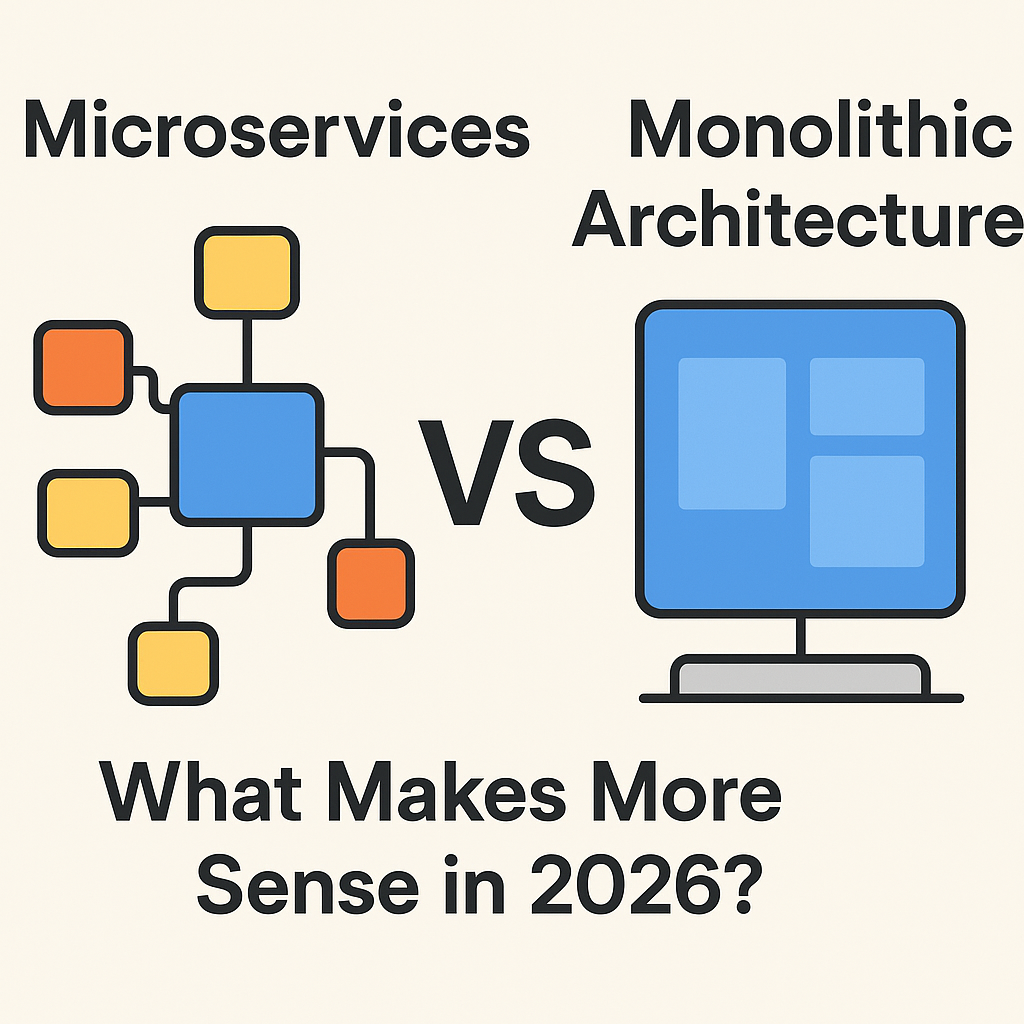
Microservices vs. Monolithic Architecture: What Makes More Sense in 2026?
The Definitions: What We’re Actually Comparing
Monolithic Architecture
Microservices Architecture
Why This Question Matters More in 2026
• Scale reliably under real traffic spikes
• Debug and trace production issues
• Control costs (compute, networking, storage, and engineering time)
• Comply with security and governance requirements
• Onboard developers and reduce cognitive load
Microservices in 2026: Strengths That Still Hold
1) Independent Scaling for Hotspots
2) Independent Deployment and Faster Delivery
3) Isolation Improves Reliability (When Coupled with Good Design)
4) Clear Ownership and Team Alignment
5) Better Fit for Complex Ecosystems
But Microservices Come with Costs (Even in 2026)
1) Operational Overhead
2) Distributed System Complexity
3) Data Consistency and Transactions
4) Versioning and Contract Management
5) Architecture Drift
Monolithic Architecture in 2026: Why Simplicity Still Wins
1) Faster Development and Lower Complexity Early On
2) Simpler Testing and Debugging
3) Stronger Consistency Options
4) Lower DevOps and Infrastructure Burden
5) Great for Product-Market Fit
The Monolith Risks in 2026 (And How to Mitigate Them)
1) The “Big Ball of Mud” Problem
2) Scaling Bottlenecks
3) Team Concurrency Issues
4) Limited Deployment Independence
A Realistic 2026 Strategy: The Spectrum Approach
Start with a Modular Monolith
Extract Microservices Gradually
• Measurable scaling or reliability needs
• Team capacity to own services end-to-end
• A proven operational foundation (observability, deployment automation)
• A data strategy that won’t create unmanageable consistency problems
Use Microservices Selectively
Technology Trends in 2026 That Influence the Choice
1) Observability Has Improved
2) Platform Engineering Is Now Mainstream
3) Cloud Managed Services Help (But Don’t Eliminate Complexity)
4) Cost Awareness Is Higher
5) AI-Assisted Development Changes Team Throughput
Decision Framework: Which Architecture Makes More Sense for You?
Choose a Modular Monolith (or Keep One) If…
• Your team is small to mid-sized
• You want simpler debugging and testing
• You need strong transactional consistency
• You haven’t yet built platform/DevOps maturity for distributed systems
Move Toward Microservices If…
• You need independent scaling for distinct workloads
• Reliability requirements demand isolation
• You can invest in observability, CI/CD, and contract governance
• The system is complex enough that modular boundaries inside a monolith would still become limiting